


-
5/16" Round Flat Washer, Stainless Steel

SKU:W-516SS
Ready to Ship5/16" Round Flat Washer, Stainless Steel
- Regular price
- $0.19
- Sale price
- $0.19
- Regular price
-
-
3/8" Round Flat Washer, Stainless Steel

SKU:W-38SS
Ready to Ship3/8" Round Flat Washer, Stainless Steel
- Regular price
- $0.18
- Sale price
- $0.18
- Regular price
-
-
1/2" Round Flat Washer, Stainless Steel

SKU:W-12SS
Ready to Ship1/2" Round Flat Washer, Stainless Steel
- Regular price
- $0.42
- Sale price
- $0.42
- Regular price
-
-
#10 Finishing Washers, Stainless Steel (100 pieces)

SKU:W-#10FinishSS-0100
Ready to Ship#10 Finishing Washers, Stainless Steel (100 pieces)
- Regular price
- $7.65
- Sale price
- $7.65
- Regular price
-
-
#10 x 1-1/4" Wood Screws, 305 Stainless, T25 Torx Drive (50 pieces)

SKU:S-1.25SS305T25-0050
Ready to Ship#10 x 1-1/4" Wood Screws, 305 Stainless, T25 Torx Drive (50 pieces)
- Regular price
- $6.72
- Sale price
- $6.72
- Regular price
-
-
3d (1-1/4") 10 Ga. Ring Shank Roofing Nails, 304 Stainless (25 Pieces)

SKU:N-03DSS304AR-P025
Ready to Ship3d (1-1/4") 10 Ga. Ring Shank Roofing Nails, 304 Stainless (25 Pieces)
- Regular price
- $3.57
- Sale price
- $3.57
- Regular price
-
-
#10 x 1-1/4" Wood Screws, 305 Stainless, T25 Torx Drive (100 pieces)

SKU:S-1.25SS305T25-0100
Ready to Ship#10 x 1-1/4" Wood Screws, 305 Stainless, T25 Torx Drive (100 pieces)
- Regular price
- $12.11
- Sale price
- $12.11
- Regular price
-
-
5/8" x 3" Hex Lag Bolt - Stainless Steel

SKU:LB-5803SS
Typically Ships in 1 to 3 Business Days5/8" x 3" Hex Lag Bolt - Stainless Steel
- Regular price
- $3.13
- Sale price
- $3.13
- Regular price
-
-
5/16" x 2" Hex Lag Bolt, Stainless Steel

SKU:LB-51602SS
Ready to Ship5/16" x 2" Hex Lag Bolt, Stainless Steel
- Regular price
- $0.81
- Sale price
- $0.81
- Regular price
-
-
5/16" x 1-1/2" Fender Washer, Stainless Steel

SKU:W-516x1.5SSF
Ready to Ship5/16" x 1-1/2" Fender Washer, Stainless Steel
- Regular price
- $0.42
- Sale price
- $0.42
- Regular price
-
-
1/2" x 7" Hex Lag Bolt, Stainless Steel

SKU:LB-1207SS
Typically Ships in 1 to 3 Business Days1/2" x 7" Hex Lag Bolt, Stainless Steel
- Regular price
- $4.27
- Sale price
- $4.27
- Regular price
-
-
#10 Finishing Washers, Stainless Steel (50 pieces)

SKU:W-#10FinishSS-0050
Typically Ships in 1 to 3 Business Days#10 Finishing Washers, Stainless Steel (50 pieces)
- Regular price
- $3.67
- Sale price
- $3.67
- Regular price
-
-
1/2" x 6" Hex Lag Bolt, Stainless Steel

SKU:LB-1206SS
Typically Ships in 1 to 3 Business Days1/2" x 6" Hex Lag Bolt, Stainless Steel
- Regular price
- $3.83
- Sale price
- $3.83
- Regular price
-


Marine Hardware: Choosing the Right Fasteners & Fittings
Salt water forgives nothing. A fastener that looks fine on the shelf can seize, streak, or fail within a season once it meets brine and vibration. Choosing marine hardware isn't about picking the shiniest bolt, it's about matching material, grade, and fitting to the job.
Here's what separates gear that lasts from gear that quietly corrodes below deck.
Key takeaways
- Marine hardware must withstand constant moisture, saltwater, and structural flex, general hardware won't suffice.
- Use 316 stainless for saltwater/submerged applications; 304 stainless or galvanized suit freshwater or budget projects.
- Thru bolts offer superior holding power for structural joints; lag bolts work for faster, secondary connections.
- Proper sizing, torque, and matching washer/nut materials prevent corrosion and connection failure over time.
What Counts as Marine Hardware
Marine hardware is the category of fasteners and fittings engineered to hold a dock, pier, or waterfront structure together under conditions that would defeat ordinary boat equipment or general-purpose supplies. When you're planning a dock build, the term covers more than a bin of bolts at the hardware store - it means components rated for constant moisture, saltwater exposure, and the flex and load of a working marine environment. Choosing correctly starts with understanding what falls under this umbrella: the fastener type suited to your connection (thru bolts versus lag bolts), the material grade appropriate to your water conditions (stainless steel or galvanized steel), and the supporting pieces - nuts, washers, and related equipment. The right quantity depends entirely on the scale and design of the structure being built. Getting these decisions right up front is what separates a dock that lasts decades from one that needs constant repair.
This article breaks down what qualifies as true marine hardware and why it matters for building a durable dock or waterfront structure. It covers key categories, deck fittings, hinges, fasteners, and snap locks, along with material choices like 304/316 stainless steel versus galvanized steel. It also explains thru bolts versus lag bolts, proper sizing, torque, and washer/nut pairings for lasting, corrosion-resistant connections.
Marine Hardware Categories: Core Products to Know
Before you spec a single fastener, it helps to understand the core products. From structural fittings to product installation hardware, these products work together to keep a dock, boat, or accessory functioning reliably in harsh saltwater conditions.
Rod Holders, Hinges and Deck Fittings
Deck fittings do more than hold gear in place, they define how a dock or boat performs day to day. Rod holders should be positioned for angle, drainage, and ease of access, with mounting hardware rated for repeated stress and saltwater exposure. Hinges deserve equal attention: a quality soft-close hinge on a hatch or door prevents slamming, while a lift-assisted hinge with a reliable stay keeps heavy lids from dropping unexpectedly, giving controlled lift and smooth, secure closing every time. Look for hardware offering a free stop function, allowing a door or lid to hold position at any angle without additional locking mechanisms. Together, these fittings, from rod holders to hinges built for constant marine use, reduce wear, improve safety, and extend the working life of everyday dock components.
Fasteners and Snap Lock Hardware
Fasteners are the quiet workhorses of any marine build, and getting the component hardware right prevents costly failures down the line. Snap lock hardware offers fast, secure attachment points for canvas, covers, and removable fittings or accessories, while a functioning lock or swivel mechanism keeps connections stable under constant motion and load. Stainless steel resists corrosion better in most marine environments, while galvanized options offer budget-friendly strength, both remain common choices depending on your project's exposure and durability needs.
Fastener selection tips
- Choose snap lock hardware for fast, secure canvas and cover attachments.
- Match lock or swivel style to the specific application's motion needs.
- Pick stainless steel for superior corrosion resistance in marine environments.
- Consider galvanized hardware for budget-friendly strength on less exposed projects.
- Inspect fasteners regularly to prevent costly failures under constant load.
Stainless Steel vs Galvanized: Corrosion Resistance and Grade
Selecting marine hardware for a dock build comes down to matching material to environment. Both stainless and galvanized options offer real strength, but their corrosion resistance and longevity differ enough to affect which hardware belongs in your project.
304 vs 316 Stainless Vs Galvanized Steel: Choosing the Right Grade
304 stainless resists rust well in freshwater and mild coastal air, but saltwater exposure will eventually reveal its limits. 316 stainless contains molybdenum, giving it superior resistance to chloride pitting, making it the standard for saltwater docks and any hardware that stays submerged. Galvanized steel, with its zinc coating, offers dependable freshwater performance at a lower cost, though the coating wears over time and won't match stainless longevity in salt environments. Grade also matters for torque: stainless fasteners tolerate higher torque loads without deforming, an important factor when securing structural connections that need to stay tight through seasonal shifts, wave action, and repeated freeze-thaw cycles.
304 vs 316 Stainless vs Galvanized Steel: Quick Comparison
| Material | Corrosion Resistance | Best Environment | Torque Tolerance | Cost & Longevity Notes |
|---|---|---|---|---|
| 304 Stainless | Resists rust well but has limits under saltwater exposure | Freshwater and mild coastal air | Tolerates higher torque loads without deforming | Reliable for non-saltwater use; less durable than 316 in salt conditions |
| 316 Stainless | Molybdenum content gives superior resistance to chloride pitting | Saltwater docks and submerged hardware | Tolerates higher torque loads without deforming | Standard choice for long-term saltwater durability |
| Galvanized Steel | Zinc coating provides dependable protection, but wears over time | Freshwater environments | Not specified as tolerating high torque like stainless | Lower cost, but shorter lifespan than stainless in salt environments |
Fastener Holding Power: Thru Bolts vs Lag Bolts
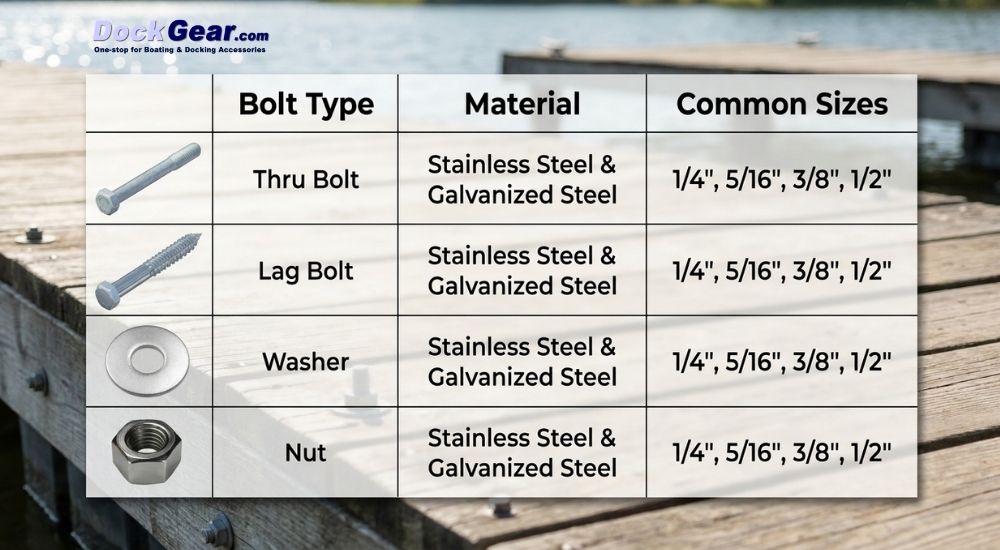
Every dock is only as strong as the hardware holding it together, and choosing between thru bolts and lag bolts is one of the first decisions that shapes long-term performance. Thru bolts pass completely through the structural members and are secured on the opposite side with a nut and washer, creating a mechanical connection that resists pull-out under repeated wave action, foot traffic, and shifting loads. Lag bolts, by contrast, thread directly into the wood and rely on that grip rather than a through-connection, making them faster to install but generally less resistant to loosening over time. For load-bearing joints — stringers to pilings, ledgers to framing — thru bolts deliver superior holding power and are worth the extra installation effort. Lag bolts still have a place for decking boards, bracing, and secondary connections where speed matters more than maximum strength. Matching the right fastener to the right joint, and pairing it with quality washers and nuts, is what keeps a boat dock tight and stable season after season.
Sizing, Torque and Washer and Nut Pairings
Getting the hardware right on a dock build isn't just about grabbing the biggest bolt available. Diameter, length, and thread pitch all need to match the load path of the connection, whether that's a thru bolt running through a stringer or a lag bolt anchoring decking into a piling. Torque matters just as much: overtightened stainless hardware can gall or snap, while undertightened connections work loose under wave action and seasonal wood movement. A properly sized bolt paired with the correct washer spreads clamping force evenly across the timber, preventing crushing at the surface and keeping the nut from backing out over time. Nuts should always match the bolt's material and thread class to avoid corrosion pairing issues below the waterline. When in doubt, size up slightly on diameter rather than length, and always seat washers flush before final torque. Correct pairings extend the life of every connection you make.
Hardware sizing quick checklist
- Match bolt diameter and length to the specific connection's load path.
- Avoid overtightening stainless hardware to prevent galling or snapping.
- Pair washers correctly to spread clamping force and prevent wood crushing.
- Match nut material and thread class to bolt to avoid corrosion.
- When unsure, size up diameter rather than length, and seat washers flush.
Pricing, Distributors and Code Compliance
Cost is rarely the whole story when sourcing dock hardware and dock products. Choosing the right distributors or online store to purchase from is an important step in finding a good price, products that are in stock and the component hardware that you need. You don't want to order and be waiting weeks to get your hardware so pick a company that provides a good website experience and indicates stock availability. No one likes delays - from a non-commercial standpoint it can be frustrating but from a commercial side it can mean loss revenue or penalties related to a job being completed on time. DockGear.com carries heavy inventory with all their marine hardware products and most website orders ship same day or next day.
Building Codes and Permitting Basics for Dock Hardware
Before ordering, check local building codes and waterfront permitting requirements, since jurisdictions often specify minimum hardware grades, corrosion resistance, and fastener spacing for dock construction. Permitting authorities may require documentation showing that thru bolts, lag bolts, and connectors meet load and material standards appropriate for marine or freshwater exposure. Working with an inspector early avoids costly rework later. Reliable hardware suppliers can typically provide certification or spec sheets that satisfy these requirements, streamlining approval. Treat code compliance as a design input, not an afterthought, it shapes material choice, fastener count, and installation method just as much as the structural engineering itself.